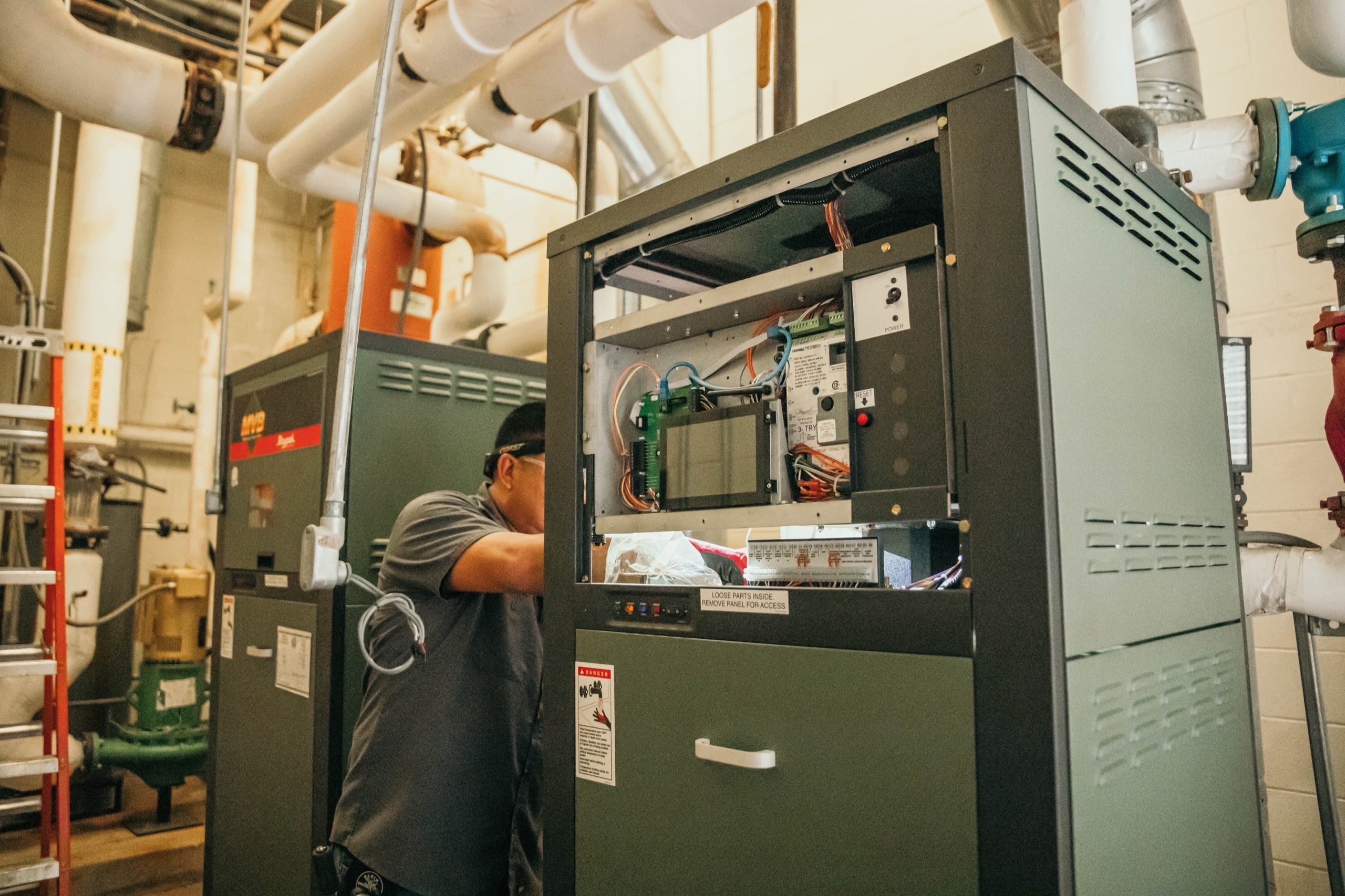
Emergency and temporary boiler rental: from failure to a unit on site
How fast a rental boiler goes live is decided by what we are tying into, not by how far the unit has to travel. What happens between the call and a unit carrying the building.
First-hand insights from the people installing, servicing, and designing boiler systems since 1977.
How fast a rental boiler goes live is decided by what we are tying into, not by how far the unit has to travel. A standard hot water unit on a two inch connection can be carrying the building the same day. A large industrial tie-in through eight inch pipe running two hundred feet takes days. The two things that move your timeline most are how early you call and whether you send photographs.
Almost every rental conversation starts the same way. Something failed, the building is cold or the process is down, and the person calling has never rented a boiler before. This is what actually happens between that call and a unit running.
The first hour is mostly information, not logistics
The instinct when a boiler goes down is to ask how fast a truck can get there. That is the wrong first question, because the truck is rarely the constraint. What we are connecting to is.
The fastest thing you can do is let us see the room. Send photographs straight away, before anybody loads a truck.
- The failed unit, including the nameplate.
- The piping around it, with something in frame for scale.
- The gas connection and the electrical supply.
- Where a trailer or a skid could physically sit, and how it would get there.
Four photographs will usually tell us more than twenty minutes on the phone. They tell us the capacity, the tie-in size, whether the unit comes on a trailer or a skid, and whether we need to solve an access problem before we solve a heating problem.
What we need to know to size the unit
A rental is not a generic box. Sizing one is the same exercise as sizing a permanent boiler, done faster.
- Hot water or steam. They are different machines doing different jobs. If the building makes steam for a process, a hot water unit is not a substitute.
- The load. What the building actually needs, which is not always what the nameplate on the failed unit says. Plants get oversized, and buildings change.
- Fuel. Natural gas, propane, oil, electric. Our fleet covers every common fuel type, but it has to match what is available at your site.
- The tie-in. Pipe size and distance. This is the single biggest driver of how long the hookup takes.
- Access and placement. Where the unit sits, what it is connected to, and whether a trailer can reach it.
If you have this in hand before you call, the quote happens in one conversation instead of three.
The tie-in is the job
This is the part that surprises people, so it is worth being upfront about it.
On an apartment complex we are usually on site within a couple of hours and working on the hookup, because tapping into a two inch line is straightforward. Domestic hot water and heating boilers are usually back up and running within 24 hours, and sometimes much faster than that.
A large industrial tie-in is a different job on a different timeline. The unit may come from out of state on a trailer, and then take days to connect through eight inch pipe running two hundred feet. Nothing about that is slow service. It is pipe fitting, and pipe fitting takes the time it takes.
When somebody asks us how fast we can get a rental boiler on site, the honest answer is that the drive is the small part. We can tell you the real number once we have seen what we are connecting to, which is why the photographs matter more than the urgency in the phone call.
Hot water or steam, skid or trailer
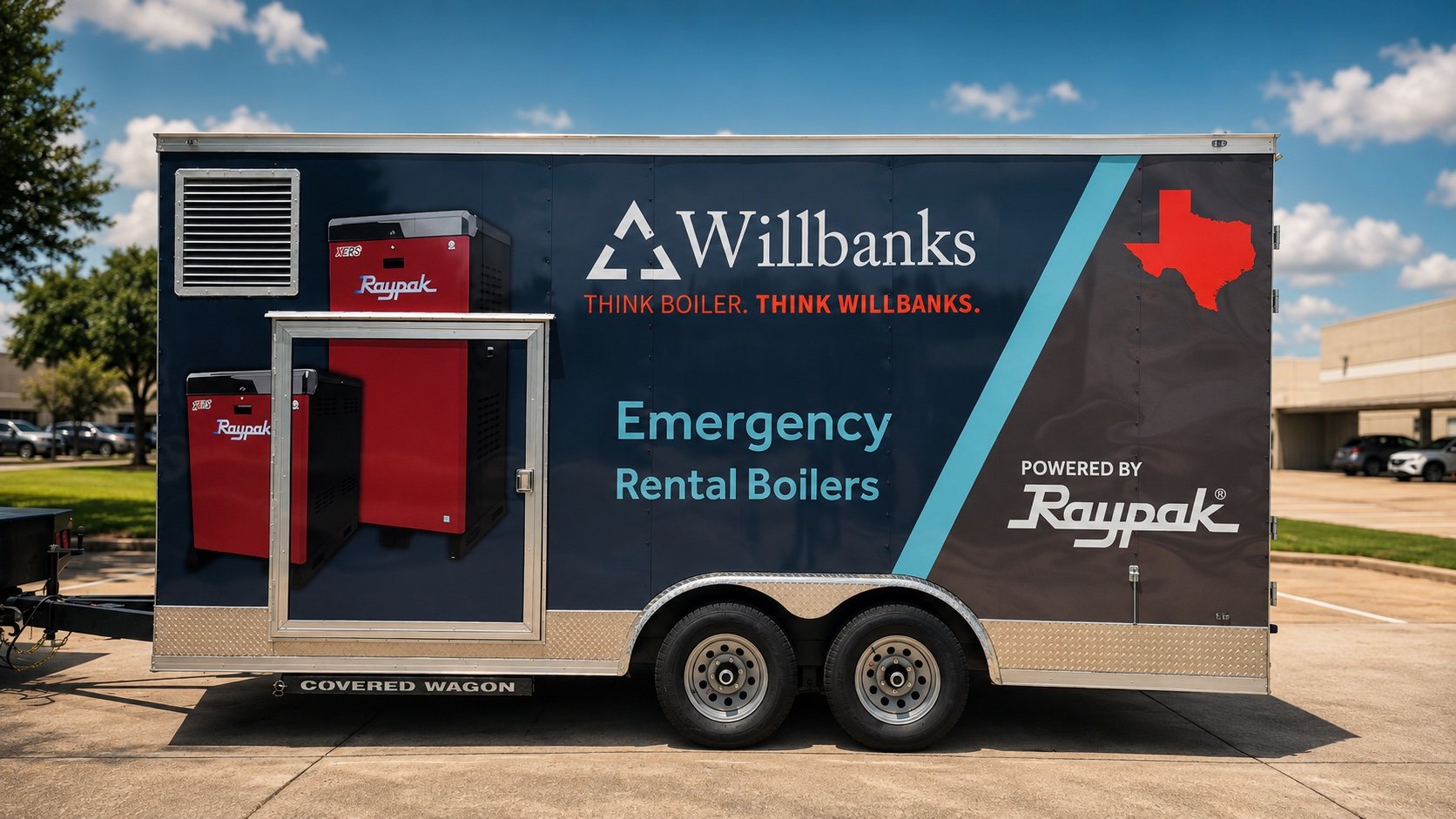
The rental fleet is staged across our Texas warehouses rather than held in one place, which is what makes same-day possible in most of the state.
- Skid-mounted and trailer-mounted units.
- Hot water and steam configurations.
- Compatible with every common fuel type.
- Booster pumps and ancillaries included.
- Short-term and long-term agreements.
Trailer-mounted units are the usual answer for an emergency, because they arrive ready to connect and leave the same way. Skids suit sites where the unit is going to live for a while, or where a trailer physically cannot get to where the connection is.
A rental is not the only way to cover downtime
This is the part most people do not know to ask about, and it is often the cheaper answer.
If the system has more than one boiler and some room to spare, we can phase the work instead. We take one unit out at a time, and the others carry the building while the replacement goes in. Nothing gets trucked in, nothing gets tied in temporarily, and nobody in the building notices anything happened.
How far we can push that depends on how much spare capacity the original design left you. A plant with three boilers sized so that two can carry the building has options. A plant with one boiler does not.
If there is only one boiler, or the rest of the system cannot carry the load on its own, that is when a rental earns its keep. It carries the building while the new unit is ordered, delivered, and installed. The point is that these are two routes to the same outcome, and which one fits comes down to how your system was designed, not to what we happen to have in the yard.
The cheapest rental is the one you saw coming
Emergency rentals and planned rentals are the same equipment. They are not the same project.
A planned rental is scoped in advance. We know the tie-in, the unit is reserved, the hookup is scheduled, and the permanent equipment is already on order. An emergency rental is all of that compressed into the same week, with a building that is already cold.
That matters most on the permanent side. A common size in a standard configuration can move fast. Large units, custom configurations, a specific burner, a long list of controls: those carry the long lead times. If your boiler is a fin tube unit coming up on 15 years, or it has started tripping its high limit repeatedly, the time to find out what the replacement lead time looks like is now, while it is still running.
Put another way, the question worth asking is not how quickly you could get a rental. It is how long you would be renting one for.
Who rents, and why
Rentals are most common in buildings where hot water is not optional and there is no redundancy to fall back on.
- Apartment complexes, where there is no second boiler and residents notice within the hour.
- Hotels, where the guest experience is the product.
- Hospitals and schools, where the building cannot simply close for a week.
- Breweries, distilleries, and food processing, where no steam means no production.
- Any plant going through a planned replacement that cannot take the unit offline.
Apartment complexes in particular tend to run to failure. As long as there is hot water nothing gets looked at, and then one morning there is no hot water and it is an emergency. When we surveyed apartment complexes across the Houston area, almost none of the owners knew the age of their boiler or the brand on the front of it. In some cases they did not know they had two, and that one of them had been down for two years.
Once the unit is on site
We connect it, commission it, and support it for as long as it is there. A rental is not a drop-off.
Agreements run short term where the unit is covering a repair or a cutover, and long term where a building needs supplemental capacity while a permanent solution is designed and ordered. There is no rule that says a rental has to be a two week arrangement. Some sit for a season.
The one thing worth deciding early is what the rental is buying time for. If it is covering a boiler that failed from scale or bad water, and the replacement goes back onto the same untreated supply, the rental has bought time rather than solved anything. The water gets looked at before the permanent unit is specified, not after.
Common questions
How fast can I get an emergency rental boiler?
It depends on the tie-in rather than the distance. A straightforward two inch connection at an apartment complex often means we are on site within a couple of hours and the building has hot water back within 24. A large industrial connection through eight inch pipe running a long distance takes days, because the hookup itself is the work.
What do you need from me to quote a rental?
Photographs of the failed unit and its nameplate, the piping and gas connection, and where a trailer or skid could sit. Beyond that, whether you need hot water or steam, what fuel is available, and roughly what load the building carries.
Can I rent a steam boiler?
Yes. The fleet covers both hot water and steam configurations in skid-mounted and trailer-mounted form. Steam is common for food and beverage, process, and older institutional plants.
How long can I keep a rental boiler?
As long as the job needs. Agreements are written short term for an emergency or a planned cutover, and long term where a building needs supplemental capacity for months while a permanent replacement is specified, ordered, and installed.
Do I need a rental if the building has more than one boiler?
Often not. If the remaining units have enough spare capacity to carry the building, we can phase the replacement instead and take one boiler out at a time. Whether that works depends on how much headroom the original design left you.
What does a commercial boiler rental cost?
It depends on the size and configuration of the unit, how long it is on site, and what the hookup involves. The hookup is the part that varies most, and it is the part an average price would hide. We price the whole job rather than quoting a daily rate on the equipment alone.
Do you rent boilers you did not install?
Yes. A rental does not depend on who installed the permanent equipment or what brand it is. On the service side Willbanks is brand agnostic.
If the boiler is down, start with photographs
Send us what you are looking at and we will tell you what it takes to get a unit on site. If it is not an emergency yet, this is the conversation worth having before it is one.